Thursday, May 9, 2013

Giving the Devil his Due

Sometimes you just gotta take your hat off to a smart gimmick, even if you really, REALLY hate the folks who did it.  Witness:


Fox News does something smart.  There, I said it.

When Lyle Overbay homered over this sign in the fifth inning last Saturday (with three generations of Rothfelds in attendance), I finally noticed this sign and its genius.

For those of you not attuned to baseball's terms of art, "power" refers to what Mr. Overbay did--hitting the ball over the fence.  Thus, when the ball cleared this sign (and in turn made its way into untold highlight shows), it made a nice impression on the viewer-- Fox News = Power.

It doesn't matter that Fox has had this sign up for at least a year, judging from a recent Yankees Classics rebroadcast I saw from last year.  I also recognize that other marketers have done this before.  The Gap placed signs in--you guessed it--the gaps in left center and right center field at both Candlestick Park and AT&T Stadium.  I just give kudos to Fox News for being clever.

Now, if they were only half so clever in their analysis of national politics...

Tuesday, May 7, 2013

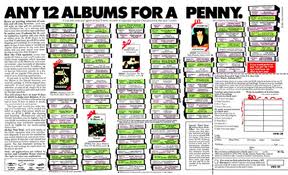
Can You Tape a Penny to a Website?

For all the jokes about Al Gore's inventing the Internet, I think we can all agree on who invested interactivity.

Lester Wunderman.

Wait, who?  You mean not Tim Berners-Lee?  Not William Gibson?  Not DARPA?

If the name Lester Wunderman seems unfamiliar to you, you probably know his best-known creation if you ever owned a record player:


Grand Funk Railroad.  Cool.

Yes, one of the founding fathers of direct marketing also invented interactivity way back in the mid-1960s.

OK, Wunderman really invented what direct marketers call an "involvement device."  Simply put, asking consumers to take an additional, essentially meaningless step, actually increased the response to the ads for Columbia House.  That is, an ad that asked consumers to tape a penny to the reply form actually got more new subscribers than a similar ad without the penny request.

I could go on to discuss why this phenomenon works (sometimes, at any rate).  However, I think we should discuss instead whether the involvement device has an analog in the digital world.

Friday, May 3, 2013

Presentation Layer is Branding for the Connected World

In my previous two posts, I discussed the limitations of using branding as the primary focus of marketing communications.  In short, the branding focus often ignores the cornucopia of information available about a brand and, perhaps more alarmingly, assumes that consumers want to engage with brands and not with content or functionality.

Before finding the solution to this problem, let's talk about something almost, but not quite, entirely unlike marketing communications, application development.  Developers create applications to help people or machines create specific tasks, such as analyzing financial trends or keeping you from drunk-dialing ex-girlfriends.

While application development takes many forms, they all have some key similarities, such as the use of a presentation layer.  The presentation layer is the part of the program that users see and interact with; the heavy-duty number crunching happens below the surface.  In all consumer-oriented applications, the thousands or millions of lines of code remain invisible.

This opacity does not mean, however, that the presentation layer does not play an important role.  The presentation layer determines how the user understands and relates to the application.  If gives him or her a concrete sense of what the application does.

By now, you should realize that, in fact, application development is at least somewhat like marketing communications.  In fact, I'll argue that presentation layer should serve as the basis for how branding works best in our connected world.

Monday, April 29, 2013

Brand Hubris

In my last post, I discussed how the brand umbrella concept favored by many ad agencies faces dire challenges in the connected world.  In short, consumers can--and will--check any brand claim against what they hear online.

However, the BS-detector element represents only part of the problem of the umbrella brand construct.  Another threat lurks in how looking at the world through the brand lens makes for bad marketing decisions.

Case in point: Mountain Dew's Green-Label entertainment website.  It features music, comedy and a complete lack of any sense at all as far as I can see.


Friday, April 26, 2013

The Brand Umbrella Works Great Until It Starts Raining Sideways

Pop quiz: what is the item pictured below?


A trick question.  Sort of.

a) That thing that keeps the rain off my head
b) That thing that KGB assassins hide poison in 
c) Pretty much the basis for all advertising strategy

As long as I've worked in advertising, we've used the umbrella as a metaphor for the relationship between the brand strategy and execution.  The brand acts as the fabric of the umbrella that holds it together and the individual executions such as mass-media campaigns, websites, promotions, etc. serve as the spokes of the umbrella.  The big brand idea informas all of the executions so that the consumer gets a consistent and relevant message across all channels.

On the whole, it works well.  Until it starts raining sideways.


Wednesday, April 24, 2013

Why the Feds Can't Connect the Dots--and What it Means to Marketers

Today's New York Times relates one of many finger-pointing episodes sure to follow in the wake of the Boston Marathon bombings, an article detailing accusations by U.S. Senators that Federal law enforcement agencies inability to share data led at least indirectly to the incident.

Georgia Republican Saxby Chambliss summed up his frustration by saying

“There have been some stone walls and stovepipes reconstructed that were probably unintentional.  We’re going to continue to look at whether or not all the information was adequately shared and given to all the law enforcement agencies. If it wasn’t, we’ve got to fix that.”

So happens, I've spent some time with one of the "stone walls" (curious choice of words for a Southerner, I reckon) that Congress very intentionally enacted to keep data bottled up in Federal agencies.  The Privacy Act of 1974 offers several lessons to marketers on its creation, use and misuse.


Tuesday, April 23, 2013

Gray is just tarnished gold

Marketers have never felt comfortable talking to older consumers as a group.  Oh, sure, they know how to crank out pharmaceutical ads featuring men with just the right amount of gray hair and they manage to find acceptably perky older women for incontinence ads.  However, most marketers focus on the 18-49 year-old audience.

Ask marketers why they don't target older consumers as a rule and you'll usually hear some variation of "less wealthy, less likely to try new products and less willing to change brands."  (Shout out to Stuart Elliott for reporting on the counter-trend).  However, they tend to ignore two key truths:


  1. Older consumers have more money.  Spend any time on my favorite US government website (you do have one, don't you?), the Bureau of Labor Statistics, and you'll quickly see that the 50+ market has all the money.  They own their own homes.  They've largely paid for their children's education.  And while they have lower incomes due to retirement or throttling back, they also have more cash on hand.
  2. Older customers do try new things.  All the time.  Some years ago, I did some initial exploratory research on the older market for a consulting project.  I interviewed anyone on the street with gray hair who would stand still long enough to chat (harder than you might think).  Most of them eagerly discussed new things that interested them, such as hobbies or travel to new places.  Clearly, they have the time and the money to try new things.

Nevertheless, older people do represent a tough audience.  I think this toughness stems from their experience.  They know how to buy things.  I'll give you a personal example.  A few years ago, I needed a new pair of khakis.  I went into a store I hadn't visited before and saw some nice-looking pants at a price that seemed a little steep to me ($60), but not out of the ballpark.

I then did something I would never have done in my twenties.  I looked inside.  There I found uneven stitching and ragged edges--seamwork so shoddy that I wouldn't have paid $20 for the pants.  That's when I glimpsed the challenge--and the opportunity--of older consumers.

To understand how to make this segment more valuable, follow the lessons of a brand that does very well with a middle-aged and up clientele: Lexus.  A recent review on Autoblog reminded me of what works:

  1. Detail.  What Lexus lacks in excitement, they more than make up for in terms of fit and finish.  You can't find an uneven panel gap in even the least expensive Lexus.  A 20-something or even a 30-something relatively new to the new car game may not notice or care about glue spots on the interior, but the senior set will.
  2. Service.  Famously, Lexus treats its customers like royalty.   Someone who's bought five to ten cars over time has had enough frustration to last a lifetime.  Affluent consumers in particular expect the red carpet all the time.
  3. Simplicity.  The unsung hero in the Lexus story is simplicity.  Yes, their cars have all the bells and whistles, something that occasionally leads to grousing from their customer group.  However, almost all their cars have all the bells and whistles, which means that a customer doesn't have to spend the mental energy figuring out what features he or she wants.  The buying process seems easier.
Anyone else have any thoughts on appeal to older consumers?  Fire away in the comments, please!