The Republicans have it all wrong: rampant spending and higher taxes have nothing to do with America’s woes. Mind you, the Democrats have it all wrong, too. Universal health care and sending every American to college will not fix America’s REAL problem.
Here’s America’s real problem:
Thursday, March 15, 2012


Monday, March 5, 2012
Kodak’s Moment
As impacts on the greater economy go, Kodak’s recent declaration of bankruptcy ranks right up there with Chrysler’s decision to shut down the Plymouth brand. After all, both Plymouth and the Great Yellow Father (as photographers called Kodak) reek of nostalgia, but both represent different times. Plymouth meant something when Richard Petty drove one in NASCAR, and Kodak meant something back when Paul Simon sang about Kodachrome.
Kodak, to most Americans nowadays, means film. Thus as consumers replaced their Instamatics with digital cameras and, eventually, phones, Kodak meant less and less. However, this tidy and nostalgic narrative elides two important details:
Point #1 makes for a tidy business school case study, but point #2 suggests that with the restructuring required by bankruptcy, Kodak has an opportunity--a Kodak moment--to build a sustainable business.
Granted, film will never retake substantial market share from digital. However, it still has a few die-hard audiences. Most obviously, technophobes cling to film. Unfortunately for Kodak, this audience gets smaller every day as film becomes more and more expensive in relation to digital and as digital gets even more idiot-proof.
The major users of film remain the fine art, commercial and hobbyist communities. Some proponents point to the superior tonality of film, a characteristic that results in more subtle grades of color and light. Others (including yours truly) simply enjoy the process of using film. Even in these niches, though, digital has made significant inroads. Newer and newer cameras and software offer closer and closer approximations of film at increasingly affordable prices.
My free advice (worth every penny) to Kodak is thus: become a luxury goods brand. Almost no one NEEDS to use film, which makes it a luxury. As a result, Kodak should consider three basic elements that characterize successful luxury brands:
Obviously, Kodak needs more than a few hundred words spouted off by someone with no history of marketing in photography. However, unless they wish to take over the mantle of “outdated industry” from the buggy whip folks, they’d better start making lemonade from those little yellow cans.
Kodak, to most Americans nowadays, means film. Thus as consumers replaced their Instamatics with digital cameras and, eventually, phones, Kodak meant less and less. However, this tidy and nostalgic narrative elides two important details:
- Kodak largely invented digital photography, but failed to capitalize on it, much in the way the Xerox failed to take advantage of the graphic user interface that Apple rode to greatness.
- More importantly, film still makes money for Kodak.
Point #1 makes for a tidy business school case study, but point #2 suggests that with the restructuring required by bankruptcy, Kodak has an opportunity--a Kodak moment--to build a sustainable business.
Granted, film will never retake substantial market share from digital. However, it still has a few die-hard audiences. Most obviously, technophobes cling to film. Unfortunately for Kodak, this audience gets smaller every day as film becomes more and more expensive in relation to digital and as digital gets even more idiot-proof.
The major users of film remain the fine art, commercial and hobbyist communities. Some proponents point to the superior tonality of film, a characteristic that results in more subtle grades of color and light. Others (including yours truly) simply enjoy the process of using film. Even in these niches, though, digital has made significant inroads. Newer and newer cameras and software offer closer and closer approximations of film at increasingly affordable prices.
My free advice (worth every penny) to Kodak is thus: become a luxury goods brand. Almost no one NEEDS to use film, which makes it a luxury. As a result, Kodak should consider three basic elements that characterize successful luxury brands:
- Form a direct relationship with all of your customers. Current, Kodak really only markets directly to large users of their products, such as commercial developers, or to recognized artists. Luxury goods, on the other hand, routinely court all users--letting them know about new and emerging products, soliciting their feedback and thanking them for their patronage. At the very least, Kodak should have an email address or social network ID of everyone who uses their film and reach out to them with a segmented communications approach.
- Focus on experience. Many photographers (read: me, at any rate) get a small thrill of opening a plastic canister and taking a whiff of the highly unnatural chemicals inside. Beyond the olfactory experience, a roll of film offers little in the way of sensory feedback. Why not use a better grade of cardboard, a more aspirational design or even a new material entirely to make the film customer feel that he or she is partaking of something remarkable? Check out the way Godiva packages their less costly treats to get an idea of luxury marketers push packaging.
- Confer status on users. Already, carrying a film camera marks a photographer as something unusual. Depending on the beholder’s point of view, it marks him or her as anything from an old coot to an artiste. Why can’t Kodak help that photographer define himself or herself with pins or other doodads that declare “expert” or “gifted amateur” or something else interesting? A basic loyalty program could help Kodak keep tabs on users’ habits and allow them to confer status based on rolls consumed or photos published to a community website.
Obviously, Kodak needs more than a few hundred words spouted off by someone with no history of marketing in photography. However, unless they wish to take over the mantle of “outdated industry” from the buggy whip folks, they’d better start making lemonade from those little yellow cans.
Thursday, December 22, 2011
Vroom vroom ding ding part II
Last week, I discussed what consumer electronics marketers could learn from their counterparts in the automotive industry. Today, let’s see if the wizards of transistors can return the favor.
While I identified three marketing practices from the auto world (sub-branding, service as a brand and racing/competition), I think that CE has only one big lesson to teach. However, as Bugs Bunny might have said, it’s a doozy.
The CE industry, just like the auto industry, thrives on features: HD video and four-wheel drive, auto-focus and turbo-charging, fashion colors and the almighty lighted vanity mirror. However, in CE, integration of those features makes powerful brands.
Thursday, December 15, 2011
Vroom vroom ding ding part I
As electric vehicles begin to become more commonplace, most of the attention has fallen on the implications of these cars and trucks on our transportation and energy systems. However, I’m paying increasing attention to the integration of two large, heavily-marketed industries: automobiles and consumer electronics.
Recently for instance, Suzuki announced that it had teamed with Panasonic to help develop an electric scooter. Until recently, Best Buy sold electric motorcycles. For that matter, the confluence of motor vehicle and consumer electronics industries hardly began with the 21st century. In 1930, Motorola got its name by way of a portmanteau incorporating “motor” and “victrola” and began producing the first radios for cars.
However, recent innovations have changed the game. While consumer electronics companies have long provided entertainment features to cars, they now supply substantial expertise in more critical areas such as battery technology, interface design and microprocessor use. Of course, I don’t really understand any of these things, so I’ll focus on what I do understand, the marketing.
With this post and the next, I’d like to discuss what I think auto and CE marketers could learn from each other. Today, I’ll start with the flow from Detroit to Akihabara.
Recently for instance, Suzuki announced that it had teamed with Panasonic to help develop an electric scooter. Until recently, Best Buy sold electric motorcycles. For that matter, the confluence of motor vehicle and consumer electronics industries hardly began with the 21st century. In 1930, Motorola got its name by way of a portmanteau incorporating “motor” and “victrola” and began producing the first radios for cars.
However, recent innovations have changed the game. While consumer electronics companies have long provided entertainment features to cars, they now supply substantial expertise in more critical areas such as battery technology, interface design and microprocessor use. Of course, I don’t really understand any of these things, so I’ll focus on what I do understand, the marketing.
With this post and the next, I’d like to discuss what I think auto and CE marketers could learn from each other. Today, I’ll start with the flow from Detroit to Akihabara.
Thursday, December 8, 2011
All I Really Need to Know about Fixing Marketing I Learned in Auto Shop
The other day, I took a look at a marketing program that a client considered underperforming. As I began to investigate, I realize that my approach resembled something I learned 25 years ago in a completely different place, the oil-slicked, unheated garage of my high school’s auto shop classroom.

Naff off, Robert Fulghum
As I looked at the components of the program, I realized that I didn’t know exactly what to look for, but instead, I knew I would find it if I kept looking for it. In broad terms, that approach applies both to marketing programs and to balky lawnmower engines.
Let me give you a little background. I attended a fine public school dedicated to sending all of its high school graduates on to higher education and they succeeded at a rate of about 85%, IIRC. As part of their goal in developing well-rounded young men and women, they insisted on two semesters of practical arts. Most of my honors-level classmates chose home economics or drafting. I had different proclivities and chose not one but two semesters of auto shop.
Tuesday, November 29, 2011
Close, But no Cyber-Cigar
Oh, Samsung, I had such high hopes for your email campaign this Holiday season. But you let me down. If I enjoyed making lame Holiday similes (disclosure: Holiday quickly makes me ill), I’d compare you to the surfboard-shaped present under the tree that turns out to be an ironing board.
However, let us learn from Sammy’s mistake.
They started out very well. I receive periodic updates from Samsung ever since I registered the phone I bought earlier this year. Updates come monthly or so, just enough to keep me interested without ever feeling overbearing. Two Sundays before Black Friday, I received this email:
However, let us learn from Sammy’s mistake.
They started out very well. I receive periodic updates from Samsung ever since I registered the phone I bought earlier this year. Updates come monthly or so, just enough to keep me interested without ever feeling overbearing. Two Sundays before Black Friday, I received this email:
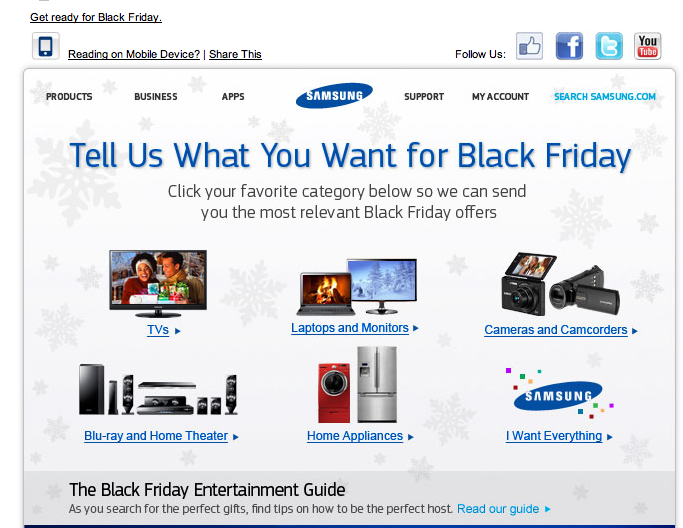
I always advocate asking customers to provide preferences and this email takes a novel and useful approach for doing so. People love Black Friday emails and certainly want the offers that matter to them without, say, $2 waffle irons. Those of you who know my proclivities know that I clicked on “cameras and camcorders.”
Thursday, November 24, 2011
When Branding Attacks!
As a casual fan of basketball, it took me a while to notice that the NBA hadn’t started playing yet. (Disclosure: I am a nominal Knicks fan, so I have trouble understanding the difference between NBA teams playing and not playing)
Sports columnists and talk radio have centered on the conflict between owners and players at the heart of the lockout, and with good reason. The “millionaires versus billionaires” conflict makes great copy and/or discussion. Certainly, money lies at the heart of the dispute.
However, I wonder if the dispute owes itself to less obvious but perhaps more systemic problem. Let’s call this problem, in the argot of Animal Planet programming, “WHEN BRANDING ATTACKS!”
Sports columnists and talk radio have centered on the conflict between owners and players at the heart of the lockout, and with good reason. The “millionaires versus billionaires” conflict makes great copy and/or discussion. Certainly, money lies at the heart of the dispute.
However, I wonder if the dispute owes itself to less obvious but perhaps more systemic problem. Let’s call this problem, in the argot of Animal Planet programming, “WHEN BRANDING ATTACKS!”
Subscribe to:
Posts (Atom)